
Ice Ice Baby — RC Berlin Workshop Recap
As guests of Dry Ice Energy at the Classic Remise in Berlin Moabit, the many members in attendance discovered not only in theory everything dry ice can do.
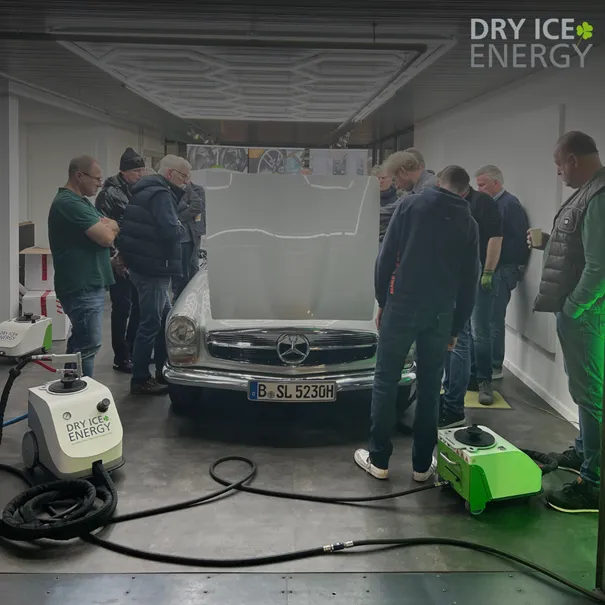
As guests of Dry Ice Energy at the Classic Remise in Berlin Moabit, the many members in attendance discovered not only in theory everything dry ice can do. They were even allowed to try it out for themselves on a Pagoda. Dry Ice Energy takes you along on an exciting day.
To kick things off, Regional Manager Sven Seehaver gave a warm welcome to the already eager members over coffee and croissants, before handing the stage over to us as the hosts. Sheila Cintuglu is the Brand Manager at Dry Ice Energy and is responsible, among other things, for communications. And who would be better suited than Sheila when it comes to giving the audience a closer look at the company?
Sheila made clear from the outset that Dry Ice Energy does not actually offer the service of dry ice blasting itself. Instead, the company is in fact the manufacturer of the dry ice blasting machines required for it. Anyone who had expected to hear a long, near-sleep-inducing monologue about the advantages of dry ice blasting and the machines from Dry Ice Energy needed for it was pleasantly surprised.
Rather, it was important to Sheila that the product should speak for itself. But what exactly is dry ice, and what can you actually do with it?
Explaining that was Christian Dewald’s responsibility. He is a technician at Dry Ice Energy, and the first thing he did was simply place a styrofoam box in the middle of the participants. Their necks craned longer and longer, since everyone wanted to see what was inside the mysterious box. But when Christian opened it, all that rose up at first was white mist. He reached into the box with a gloved hand and pulled out white pellets. The dry ice!
In reverent silence, the participants examined the pellets steaming in the palms of their hands, like villagers of old at a medieval market. In our case, this was solid carbon dioxide (CO₂). At normal pressure, dry ice is no warmer than −78.4° C. When warmed, it does not melt but instead passes directly into gaseous carbon dioxide. This process is called sublimation.
The dry ice pellets from Dry Ice Energy come in two sizes, 1.5 and 3.0 mm. They are produced in a special process under high pressure. This gives them a particularly high density and firmness, which in turn makes them long-lasting — something that matters for transport. On top of that, this results in increased cleaning performance in automotive detailing.
Cleaning performance was the keyword, and the reason for the workshop. Christian filled a small scoop with dry ice and tipped it into a small machine that bears a striking resemblance to a vacuum cleaner. He connected a compressed-air hose to this “vacuum cleaner”. On the other end he had attached a kind of gun.