
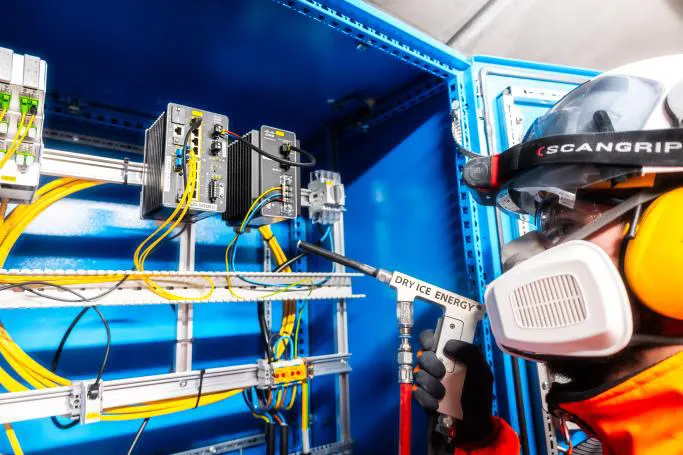
Challenges in cleaning electronic components
Electronic components such as control cabinets, control systems, circuit boards and PCBs are inevitably exposed to dust and dirt in production environments. These deposits can impair the operation of the electronics, cause short circuits and shorten the service life of the equipment. Regular cleaning is therefore essential to ensure proper function and safety. Traditional methods such as cleaning with water or chemical agents are often unsuitable, as they can leave behind moisture that causes further damage.
How dry ice blasting works
Dry ice cleaning is a modern process based on the use of dry ice pellets. The pellets are blasted at high speed onto the surface to be cleaned, where the dry ice sublimates and removes dirt particles.
Dry cleaning process
In dry ice blasting, dry ice pellets are accelerated with compressed air and blasted onto the soiled surface. The pellets strike the surface at high speed and sublimate instantly — that is, they convert directly from solid CO₂ into gaseous CO₂. The process leaves no residue behind apart from the loosened dirt. The cold of the dry ice pellets (-79 °C) causes the dirt to freeze and crack, making it easier to remove.
Effective fire protection
Another advantage of dry ice blasting is effective fire protection. Since dry ice generates no sparks or heat, the risk of fires or explosions is minimised. This is particularly important in environments where flammable materials or hazardous substances are present. In addition, thorough cleaning with dry ice blasting prevents the build-up of smouldering deposits that could pose a fire hazard.
Chemical-free cleaning
Dry ice blasting is a completely chemical-free cleaning process. Neither cleaning agents nor solvents are required, which makes the method environmentally friendly and safe for use across various industries. This is particularly advantageous for the food, pharmaceutical and electronics industries, where the use of chemicals is subject to strict regulations. Dry ice blasting devices are therefore ideally suited for control cabinet cleaning.
Legal framework
The cleaning and maintenance of control cabinets and other electrical installations is subject to strict legal regulations. These regulations serve to ensure the safety and proper operation of the systems.
Industrial Safety Regulation (BetrSichV)
Under the German Industrial Safety Regulation (BetrSichV), companies are obliged to regularly maintain and inspect their electrical installations. This also includes cleaning the installations to ensure their proper function and safety. The BetrSichV stipulates that electrical installations must be inspected for proper condition at defined intervals.
BGV A3 §5: employer's inspection duties
Under BGV A3 §5, the employer is responsible for ensuring that electrical installations and equipment are regularly inspected for proper condition.
In practice, this means that thorough cleaning is often required to maintain the safe and proper condition of the installations. Dry ice blasting represents an ideal solution here, as it enables effective cleaning without water or chemicals.
Application benefits
Dry ice blasting is a versatile and practical method for cleaning electronic components, proven across numerous application areas.
Non-electrically conductive — cleaning during operation
Thanks to the non-electrical conductivity of dry ice, control cabinets and other electrical installations can be cleaned during operation. This has the advantage that machines do not need to be shut down. As a result, downtime is minimised and productivity is increased.
Improved operational safety
Regular cleaning with dry ice blasting contributes to improved operational safety. By removing dust, dirt and other deposits, short circuits and other electrical problems are prevented. This extends the service life of the installations and reduces maintenance costs.
Residue-free cleaning
Dry ice blasting is a particularly effective method for cleaning electronic components, as it leaves no residue behind. Cleaning with dry ice requires no additional cleaning effort. In addition, no chemical residues are released into the environment.
Compliance with legal regulations
Regular cleaning and maintenance of control cabinets in accordance with legal regulations ensures that the installations can be operated safely and properly. Dry ice blasting meets the requirements of the Industrial Safety Regulation and other legal provisions by providing an effective and environmentally friendly cleaning method.
Safety instructions for dry ice cleaning
Dry ice cleaning is a safe and effective process, but it requires certain safety measures to prevent accidents and damage. However, as with all blasting and compressed-air devices, there are several safety instructions to follow when using dry ice blasting devices.
Personal protective equipment (PPE)
When working with dry ice blasting devices, wearing the right personal protective equipment (PPE) is essential. The following items should always be worn:
- Protective gloves: to protect against cold burns from contact with dry ice.
- Eye protection: safety glasses or face shields to protect the eyes from flying particles.
- Hearing protection: ear muffs or plugs to protect hearing from the noise of the blasting device.
- Protective clothing: long-sleeved tops and trousers to protect the skin from direct contact with dry ice.
Handling dry ice
Dry ice has extremely low temperatures (-79 °C) and can cause cold burns if handled improperly. Therefore, observe the following points:
- Avoid direct skin contact: never touch dry ice with bare hands. Always use suitable protective gloves.
- Ensure ventilation: since dry ice consists of CO₂, which is converted into gas during sublimation, the work area must be well ventilated to avoid a build-up of CO₂.
Operating the dry ice blasting device
Safety measures when operating the dry ice blasting device are crucial in order to avoid accidents and damage:
- Check the device before use: inspect the dry ice blasting device before each use for visible damage or wear.
- Follow the operating manual: always read and follow the manufacturer's instructions for safe operation of the device.
- Secure the work area: ensure the work area is free of uninvolved persons and mark the area if necessary.
Conclusion
Dry ice blasting is an innovative and effective method for cleaning control cabinets and other electronic components. It offers numerous advantages, including dry and chemical-free cleaning, effective fire protection, speed and efficiency, and the possibility of cleaning during operation. It also meets legal requirements and contributes to improved operational safety.
Summary of the benefits
The most important advantages of dry ice blasting include:
- Dry cleaning process with no residue
- Effective fire protection
- Chemical-free and environmentally friendly cleaning
- Speed and efficiency
- Possibility of cleaning during operation
- Improved operational safety
- Compliance with legal regulations