
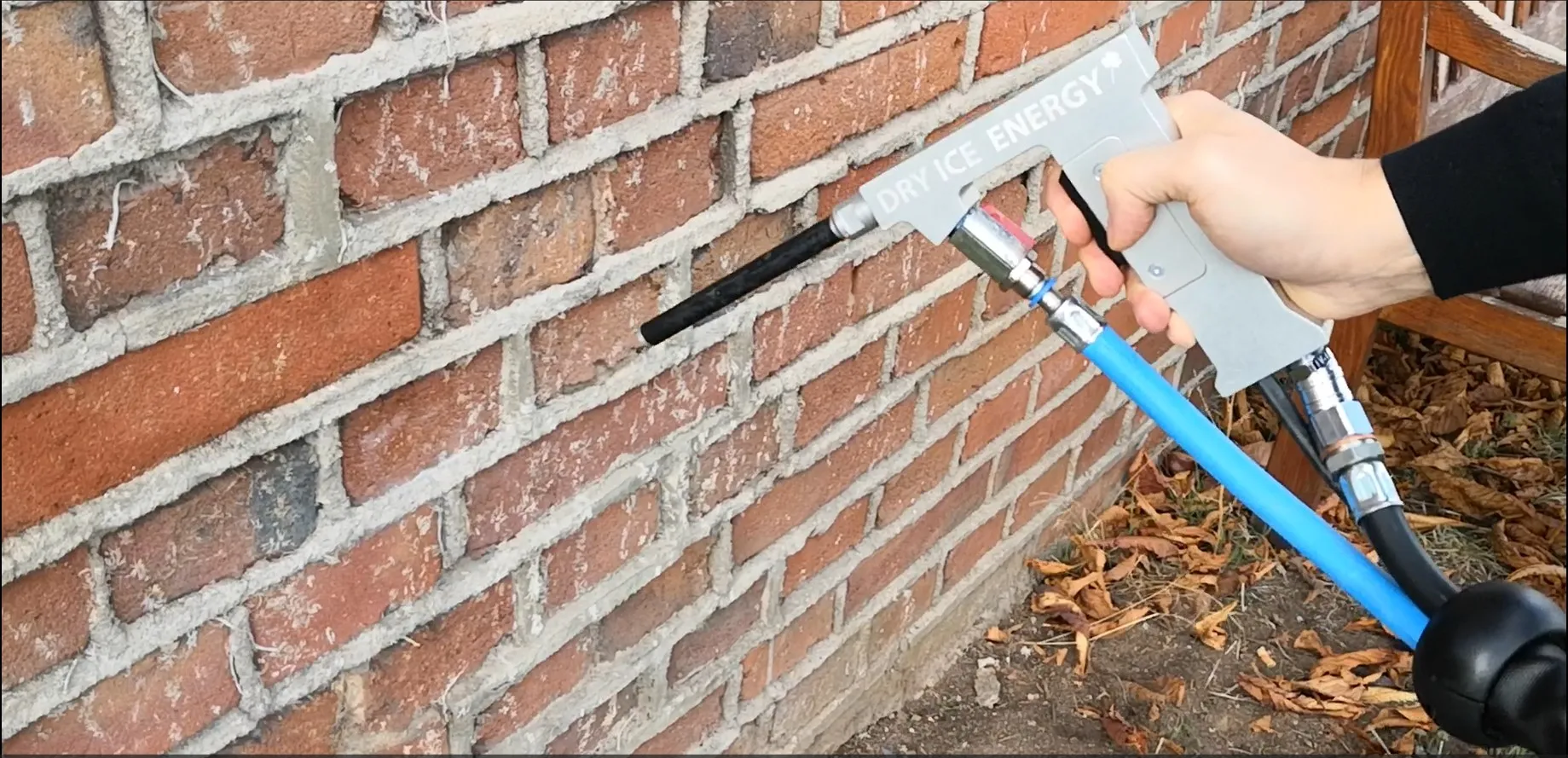
Façade cleaning with dry ice: how effective is it?
We explain how dry ice façade cleaning works, what advantages this innovative method offers compared to conventional cleaning procedures, which façade types it suits — and why investing in dry ice usually pays off economically as well.
Challenges of façade cleaning without dry ice
Cleaning a façade or clinker brick surface is an extensive process that often interferes with normal operations or even brings them to a halt. Conventional cleaning methods using chemical substances or high-pressure water can attack the surface structure of buildings or loosen joint material. In the long term, this damages the building fabric — for instance through cracks or the ingress of moisture. The logistical effort involved should not be underestimated either: this type of façade cleaning requires scaffolding, barriers and drying times that can stretch over several days. Operations are massively disrupted, and entire sections of the business may become inaccessible.
What changes when you clean a façade with dry ice
Given these demands, interest in alternative methods is growing — methods that not only clean but also meet today's standards for sustainability, cost-efficiency and technical excellence. Dry ice blasting meets exactly these expectations — a cleaning process built around modern requirements that has already established itself across many industries.
Dry ice façade cleaning gives you an environmentally and health-friendly alternative to conventional cleaning with chemical or water-intensive methods. On top of that, dry ice façade cleaning offers significant cost savings, since there are no follow-up costs from post-treatment or the disposal of used materials.
For companies focused on long-term value retention, predictable processes and innovative technologies, dry ice façade cleaning is increasingly becoming a strategic choice within their maintenance and servicing strategies.
What advantages does dry ice façade cleaning offer?
Dry ice façade cleaning offers numerous benefits, which is why more and more companies decide to buy dry ice. The reasons why this innovative method is so effective and economical are manifold:
- Material-friendly: Dry ice cleaning removes dirt and deposits without damaging the façade — particularly important for sensitive materials such as clinker bricks or natural stone.
- No water-related risk: Because the process works completely without water, no moisture penetrates the masonry, preventing long-term damage from mould.
- Residue-free cleaning: After treatment, no moisture or detergent residues remain.
- Sustainability: Dry ice blasting is an environmentally friendly process that works without chemicals, making it ideal for companies that value sustainability and occupational health.
- Efficiency and speed: The process is fast, precise and requires no elaborate post-treatment, keeping downtime to a minimum and avoiding unnecessary disruption.
How does façade cleaning with dry ice blasting work?
When applying a dry ice blasting device, small pellets of frozen CO₂ are propelled at high speed onto the façade surface, producing a highly effective cleaning effect that works in three ways at once — without damaging the surface.
- Thermal embrittlement: The ultra-cold dry ice pellets (-78.5 °C) cause a sudden thermal shock. Contaminants such as paint, algae, soot or environmental deposits contract, become brittle and lose their bond to the surface.
- Powerful cleaning through high impact velocity: Thanks to the high acceleration, the embrittled particles are lifted from the substrate — completely without abrasive action. The original structure of the façade remains fully intact.
- Residue-free sublimation: Upon impact, the dry ice transitions directly from solid to gaseous state. What remains is a clean, dry surface — without moisture, residues or disposal effort.
Render or clinker? Dry ice blasting in practice
Dry ice façade cleaning is used in many different areas. On large industrial buildings or office complexes, dry ice blasting effectively removes graffiti, environmental residues and other deposits without causing any water damage. Listed buildings in particular can be cleaned ideally with dry ice blasting. Sensitive façade materials such as natural stone or historic render surfaces are damaged neither by aggressive chemicals nor by mechanical methods. Last but not least, dry ice façade cleaning is an excellent option for removing dirt and other deposits from outdoor sculptures or works of art.
Are you considering using this innovative cleaning method yourself? Get in touch with us. As specialists in modern dry ice blasting devices, Dry Ice Energy advises you comprehensively. Contact us quickly and easily for more information on dry ice façade cleaning.